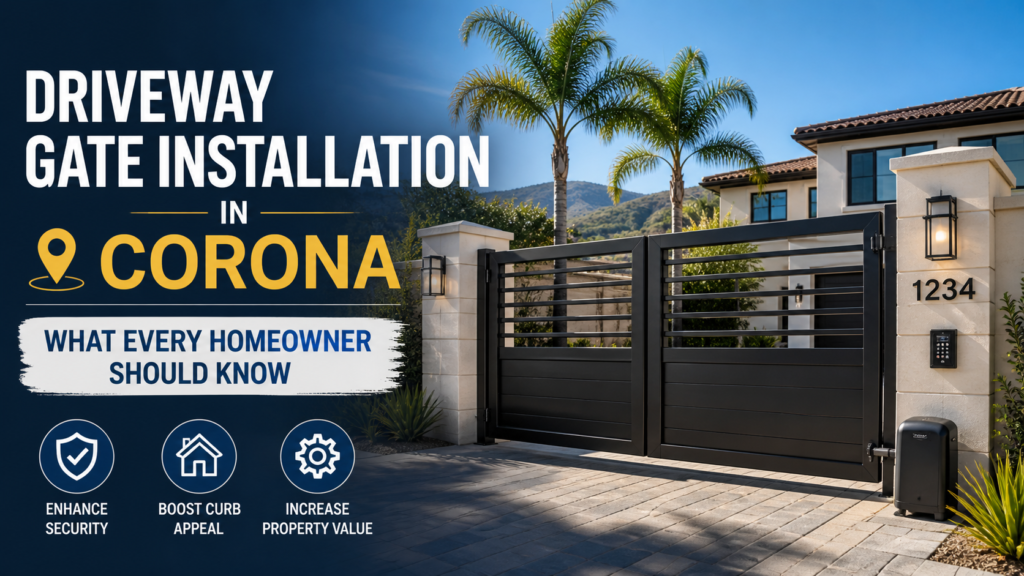
A driveway gate is one of the most meaningful structural additions a homeowner can make to their property. Beyond its obvious visual impact, a well-installed driveway gate serves as a physical statement that communicates security, privacy, and pride of ownership. For residents of Corona, California, where the community blends residential charm with suburban growth, understanding what goes into a proper Driveway Gate Installation Corona is the first step toward making an informed decision.
What Is a Driveway Gate and Why Does It Matter?
A driveway gate is a barrier installed at the entry point of a property’s driveway to manage and control vehicle access. Unlike decorative fencing or garden gates, a driveway gate is specifically engineered to accommodate the width required for cars, trucks, and other vehicles. These gates are typically between 10 and 18 feet wide, depending on whether the entry accommodates single-lane or dual-lane traffic.
In communities like Corona, where properties range from compact residential lots to larger ranch-style estates, driveway gates serve several practical purposes. They regulate who can enter a property, provide a deterrent against trespassing, add a layer of privacy, and contribute meaningfully to curb appeal. For families with young children or pets, they also offer peace of mind by preventing unintended access to or from the driveway.
Common Types of Driveway Gates
Understanding the types of driveway gates available helps homeowners choose the right fit for their property’s layout and needs.
- Swing Gates: These open inward or outward on hinges, much like a standard door. They are the most traditional style and work well on level driveways with enough clearance for the gate to arc open without obstruction. Single and double swing configurations are both available.
- Sliding Gates: These move horizontally along a track parallel to the fence or wall line. They are ideal for properties with sloped driveways or limited turning space, as they do not require a wide arc to open.
- Automatic/Electric Gates: Either swing or sliding gates can be automated with a motorised operator, allowing the gate to be opened and closed via a remote control, keypad, intercom, or smartphone app.
- Wrought Iron Gates: A popular aesthetic choice in Southern California, wrought iron gates are durable and customisable, offering decorative elements that complement a range of architectural styles.
- Wooden Gates: These provide a natural, warm appearance and can be custom-built to a variety of heights and widths. They require regular maintenance to prevent warping and weather damage.
- Aluminium and Steel Gates: These modern options offer strength with lower maintenance requirements. They resist rust and corrosion well, making them practical for properties exposed to the elements.
Key Considerations Before Installation
Several factors influence how a driveway gate installation should be approached in Corona.
Driveway Width and Layout: The gate must be wide enough to accommodate the vehicles that will use the entry. Single driveways generally need a gate of 10 to 12 feet, while double driveways may require 14 to 18 feet or more. The terrain on either side of the entry also determines whether a swing or sliding gate is more appropriate.
Post and Foundation Strength: The gate posts must be deeply anchored and properly set in concrete to bear the weight and movement of the gate panel. Poorly anchored posts are one of the most common causes of gate failure over time.
Space for Operation: Swing gates need clearance to arc open fully, which means vehicles must be far enough back from the gate during operation. Sliding gates need lateral space along the fence line into which the panel can retract.
Automation: If the gate is to be automated, power supply considerations come into play. An electrical connection must be available near the gate operator’s mounting location. Solar-powered operators are an option for locations where running power lines would be impractical.
Local Regulations: The City of Corona has its own street and driveway standards, including specifications for private street gate placement relative to the roadway and sight distance requirements. It is important that any driveway gate installation complies with applicable local codes.
Materials and Their Characteristics
The choice of material for a driveway gate affects its appearance, durability, and maintenance requirements.
Wrought iron and steel are preferred where strength and security are the primary concerns. These metals can be powder-coated for weather resistance and are available in a broad range of ornamental designs. Wood adds warmth and a natural aesthetic but requires regular sealing, painting, or staining to prevent deterioration in the Inland Empire’s climate. Aluminium offers a lightweight alternative that resists corrosion and still allows for decorative customisation. Vinyl gates have also grown in popularity for their low maintenance requirements, though they can present challenges when it comes to automating, as the material needs additional reinforcement at connection points.
How the Installation Process Works
A professional driveway gate installation follows a structured process that begins with a site assessment. During this phase, the installer evaluates the terrain, measures the opening, identifies where the posts will go, and discusses material and style preferences with the homeowner.
Once the design is finalised, the installation crew sets the posts typically by digging holes to the required depth and pouring concrete footings. After the concrete has cured, the gate panels are hung or mounted onto the posts. If the installation includes automation, the operator unit is mounted, electrical connections are made, and the control system (remote, keypad, or access panel) is configured. The final step involves testing the gate for smooth, balanced operation and verifying that safety features such as auto-reverse sensors are functioning correctly.
Maintenance and Longevity
A properly installed driveway gate, when maintained correctly, can serve a property for many years. Regular maintenance involves lubricating hinges, rollers, and tracks; inspecting and tightening hardware; checking for signs of rust, rot, or corrosion; and testing the automation system if one is present. Wood gates should be inspected seasonally and refinished as needed. Metal gates benefit from periodic inspection of welds and powder coating for chips or peeling.
Conclusion
A driveway gate installation in Corona is a long-term investment that touches on security, aesthetics, and property value all at once. Taking the time to understand the different gate types, the site requirements, and the installation process helps ensure that the end result is a gate that performs reliably and enhances the property for years to come. Whether the goal is a simple manual gate or a fully automated system with remote access, the fundamentals of good installation always begin with careful planning and quality materials.